THE FIRST COLLECTION·Preorders planned for October 10, 2026Explore the sets
USD $
Material history
A short history of cork, from bark to everyday design
Explore cork’s history, from ancient fishing floats and Robert Hooke’s microscope to modern design, and discover the material behind your everyday coaster.
A wine bottle, a noticeboard and a coaster do not seem to have much in common. Cork gives them a family resemblance: warm brown colour, a little give, a surface that never looks entirely uniform.
Follow that modest material backwards and the story grows surprisingly wide. There are fishing nets, a seventeenth-century microscope and, much later, rocket insulation. The pleasure is in seeing how a familiar material keeps finding another job.
First, a tree with unusually thick bark
The cork oak, Quercus suber, develops an exceptionally thick outer bark. Royal Botanic Gardens, Kew describes how skilled harvesting removes this layer without cutting down the tree. The tree is the beginning of the material’s story, rather than a shape that has to be turned into timber.
That distinction is easy to miss once cork has become a neat disc. The rough outside of the tree and the smooth sheet on a table look like distant relatives. Between them lie decisions about harvesting, selection and the kind of object the material will become.
Kew’s account points to cork fishing floats from around 5,000 years ago and a corked wine container around 2,000 years old. Low density suited a float; compressibility and resistance to liquid suited a closure. Different needs drew attention to different qualities of the same bark.
There is something satisfying about those early uses. A float does not need to look impressive to be useful. It needs to keep doing its small job. That is a good starting point for thinking about everyday design, including the objects we barely notice until they are missing.
In 1665, Robert Hooke’s Micrographia brought microscopic observations to readers through detailed illustrations. The Royal Society’s collection preserves the plate showing cork beside part of a sensitive plant. Look at the image and the material becomes a landscape of tiny compartments.
That shift in scale is still compelling. A coaster looks solid in the hand; under magnification, cork has a much more intricate organisation. You do not need a microscope to enjoy the texture, but the drawing is a lovely reminder that ordinary objects can reward a closer look.
APCOR, the Portuguese cork industry association, describes harvesting as specialist manual work that requires experience to avoid damaging the tree. It also distinguishes the irregular material from early harvests from later cork suited to natural stoppers. Material from different stages has different uses.
Modern manufacturing widens those possibilities. Cork granules can be joined into sheets using binding agents, with particle size and density selected for the application. This helps explain why a floor tile, a gasket and a coaster can all contain cork while feeling quite different. The finished object has a manufacturing history as well as a botanical one.
NASA’s 2018 account of thermal protection for the Space Launch System describes cork sheets fitted to selected areas with high predicted heat loads. Engineers checked density, adhesion and thickness as part of that work. Cork sat within a carefully specified system alongside other insulation materials.
It is a wonderful addition to the material’s biography. It also shows how much the application matters: an engineered rocket component and the cork beside your coffee are very different objects. What connects them is the willingness to look closely at a material and choose how to use it.
Cork’s long history adds interest to a small purchase, but the everyday questions remain wonderfully simple. Does the object feel good to use? Do its parts fit? Will its owner know how to care for it? A material story is most enjoyable when the object itself deserves attention.
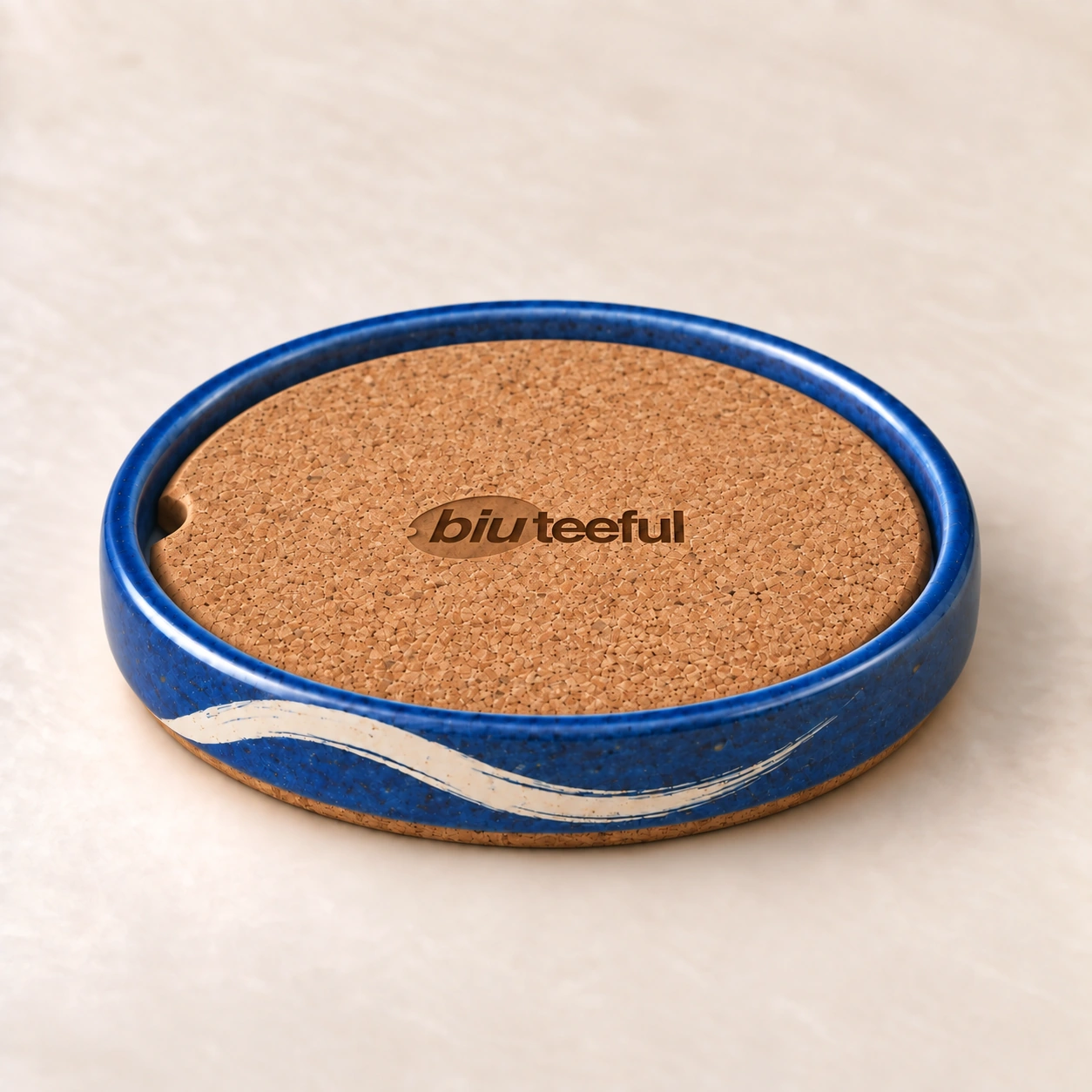
For Biuteeful, the design idea is to pair cork’s familiar texture with a ceramic body you want to keep. A removable top and replaceable base give those parts separate roles. The next chapter belongs to the finished design and the ordinary tables it is made for.
A few common questions
Is cork wood?
The cork used in products comes from a cork oak’s outer bark. It is distinct from the timber inside the tree, which is why cork can be harvested without felling the oak.
Why can two cork products feel so different?
They may use different forms of cork, particle sizes, binding agents, thicknesses or surface finishes. The material is adapted to the object, so the word cork alone does not describe a complete specification.
Looking for sustainable coasters? Compare what you already own, replacement parts, care and disposal before choosing cork, ceramic or another material.
Create corporate event gifts that feel at home after the occasion, with considered branding, useful care cards and a thoughtful handover to recipients.