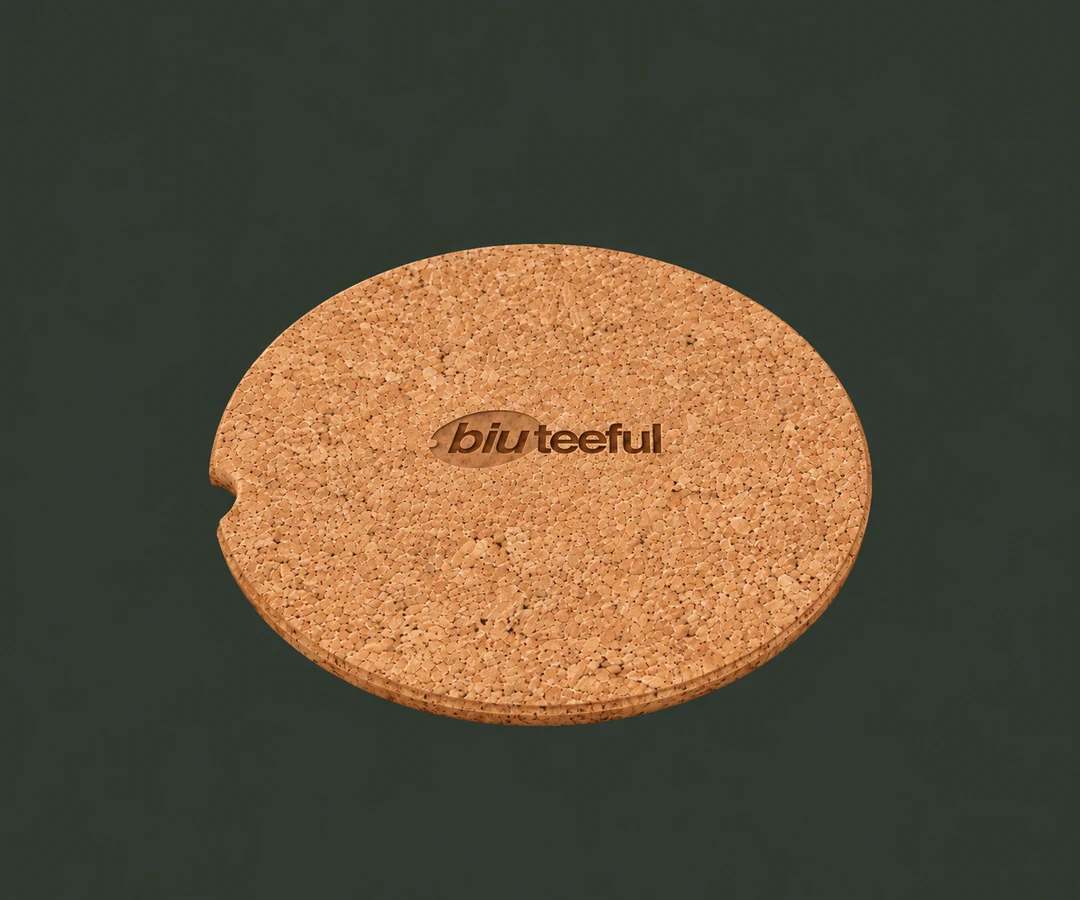
Cork is easy to like in a photograph. Warm colour, a little texture, a familiar material beside a favourite cup. Choosing between two cork coasters is harder. One has a fine, even grain; another looks more rugged. Which is better?
The useful answer starts with the object you will actually live with. A coaster needs to sit well, feel considered and make sense after the first spill. Here is what to look at before the word ‘premium’ does all the work.
Grain tells part of the story
Many cork sheets are made from granules joined into an agglomerate. APCOR, the Portuguese cork industry association, describes how granule size, density, binding agents and finishing are chosen for different applications. A cork layer may also have a coating or be combined with another material. Two pieces that look similar can therefore have different constructions.
Fine grain can give a quiet, even appearance. A larger grain can make the material feel more expressive. Treat that as a design preference until you have the specification and a sample. Neither look, on its own, tells you how neatly the edge will wear or how the finished part will behave when damp.
Cork contains microscopic, gas-filled cells. APCOR connects this structure with its lightness, compressibility and low thermal conductivity; suberin in the cell walls contributes to water resistance. Those properties help explain why designers keep returning to cork.
They do not tell you how much condensation a particular coaster can manage. The thickness, surface treatment, edges and other components all belong in that conversation. Ask a practical question: what happens to the water during a long iced drink, and what should I do afterwards? A useful product description should help you picture both moments.
A sample review need not be complicated. Put the coaster on a washable tray and bring out the wide mug, narrow tumbler and cold-drink glass you reach for most often. Start with everything dry. Notice the details you would find irritating if they happened every morning.
For a set intended as a corporate gift, let someone who has not seen the design try it too. If the cork is removable, can they find the lift point without an explanation? That small moment tells you something useful about the product and its instructions.
Does each cup sit level, with enough room around its base?
Are the cork edges tidy, with no loose particles coming away during normal handling?
Does a removable insert sit flat and go back into place easily?
Can you see and dry the areas where moisture collects?
Look closely at a custom logo
If you are ordering branded cork coasters, inspect the mark at its intended size. Large artwork on a screen can hide letters that become crowded when engraved. Ask for a physical sample of the proposed cork and artwork, then look at it in ordinary room light.
Aim for lettering that stays readable while allowing the cork texture to remain visible. Check a few samples side by side: mark size, placement and contrast should feel consistent even when the grain varies. Keep the approved sample and artwork together, so everyone has the same reference when production is discussed.
A good replacement should be easy to identify
For a coaster with replaceable cork, the future refill is part of the buying decision. Save the part name, dimensions and fitting method. A removable upper insert and an adhesive-backed base do different jobs, even when both are described simply as cork.
Ask where the matching part will be listed and whether a new version will still fit. The appeal of keeping a favourite ceramic body depends on being able to find the right cork later. Clear information is a useful quality detail too.
A few common questions
Is a thicker cork coaster always better?
Thickness is one part of the design. Check cup stability, edge finish, how water is handled and whether the coaster fits your storage space. For a replacement insert, use the specified thickness; a thicker substitute may not seat correctly.
Can a photograph show whether cork is high quality?
It can show visible finish and the intended appearance, but it cannot establish fit, feel or performance. For a sizeable or customised order, use a physical sample to approve those details.
What should I ask a cork coaster supplier?
Ask about cork construction, coatings, care, dimensions and any replaceable parts. For logo work, request a sample with your actual artwork and confirm which production details that sample represents.
Learn when a cork coaster insert needs cleaning, drying or replacing, how to check each part, and why a ready spare makes everyday care easier to manage.
Explore cork’s history, from ancient fishing floats and Robert Hooke’s microscope to modern design, and discover the material behind your everyday coaster.
Choosing corporate gifts people will use? A practical guide to custom coasters, physical samples, thoughtful branding and the details behind a good quote.